

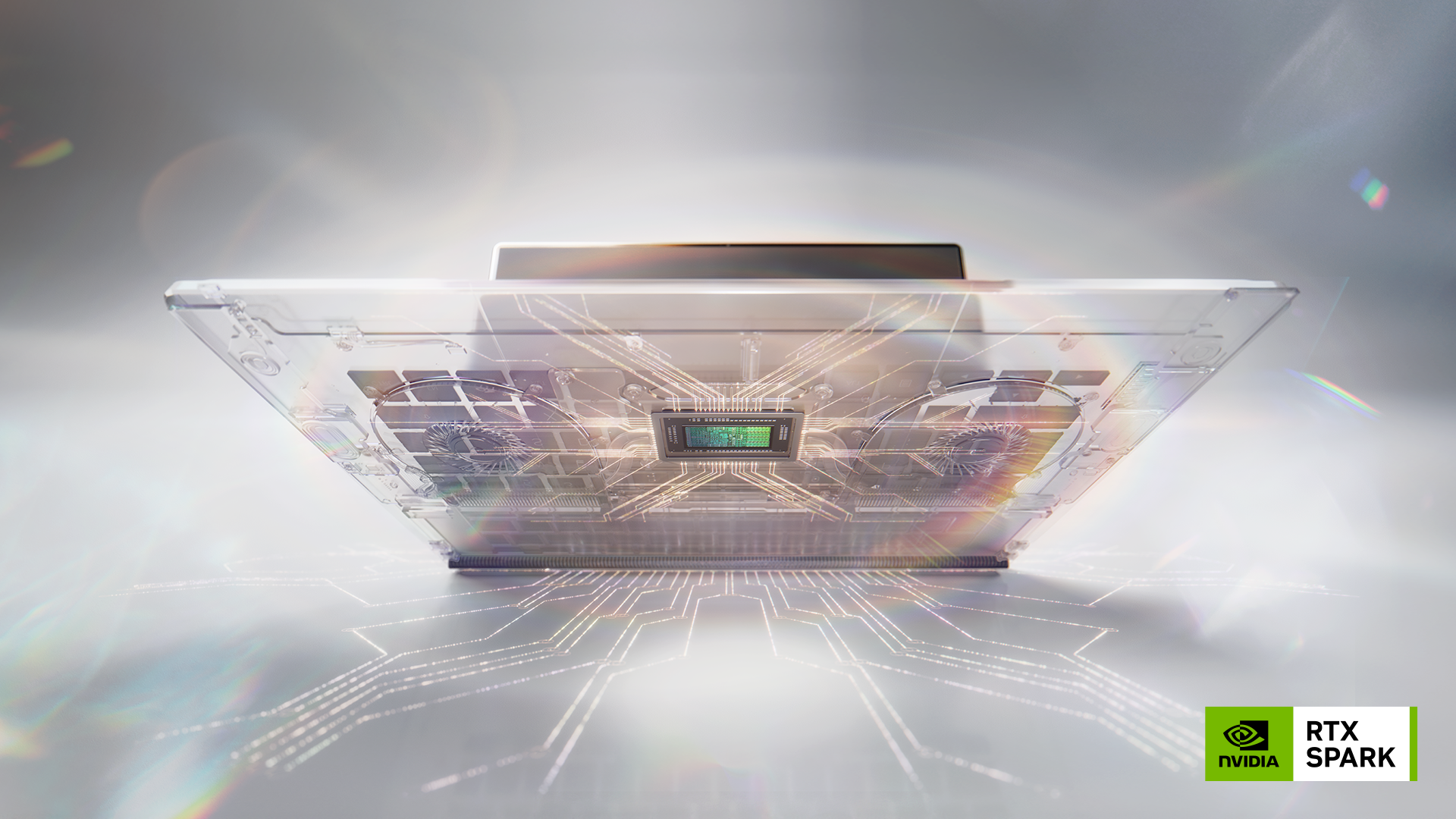
At Computex 2026, NVIDIA announced the RTX Spark superchip, a hardware component developed for integrating local AI agents on Windows PCs. The result of a collaboration with Microsoft, the chip delivers 1 petaflop of AI computing power and supports up to 128GB of unified memory.
The system uses NVIDIA OpenShell technology to ensure agents run securely on the primary hardware device. The first laptops and compact desktop PCs equipped with RTX Spark will ship this fall from manufacturers including ASUS, Dell, HP, Lenovo, Microsoft Surface, and MSI, with Acer and GIGABYTE to follow later. Adobe is also working to revamp Photoshop and Premiere to double graphics and AI performance on these systems.
NVIDIA also announced DLSS 4.5 Ray Reconstruction, due in August. The software uses a second-generation Transformer model to increase image quality in games that use ray tracing and path tracing. The stated specifications include:
-
Denoiser module: Increase the 35%'s computing power and manage more parameters than the 20% while maintaining the same overall performance.
-
Advanced Super Resolution: Increased temporal stability and global illumination accuracy through analysis of game engine motion data.
-
Extended training dataset: Optimizing visual fidelity to ground truth for scene reconstruction.
-
Developer Control: Time sync management for fine image calibration.
Ray Reconstruction technology will also be implemented this fall in Blender 5.3 as a denoiser.
On the gaming software front, NVIDIA confirmed that it has surpassed 1,000 titles and applications compatible with the RTX ecosystem. Eleven new games will receive DLSS 4.5 integration, including Backrooms: Escape Together, CINDER CITY, Duet Night Abyss, Gothic 1 Remake, Hell Let Loose: Vietnam, Honeycomb: The World Beyond, Marvel Rivals, NARAKA: BLADEPOINT, Phantom Blade Zero, Squad e Where Winds Meet.
Hardware partners unveiled new GeForce RTX 50-series graphics card models from ASUS and GIGABYTE, as well as laptop configurations featuring up to the GeForce RTX 5090 GPU and desktop systems with the RTX 5080 and RTX 5090. G-SYNC-compatible monitors capable of reaching refresh rates of 540Hz and 1000Hz will also be released.
Regarding the infrastructure for developing and running local AI, inference model optimizations have resulted in a 2x performance increase on llama.cpp and a 2.6x performance increase on vLLM. The open-source Hermes Agent and OpenClaw projects will natively integrate OpenShell libraries on Windows, while the NVIDIA NemoClaw installer is being made available for Linux and WSL systems.
Unreal Engine 5 developer tools now include the official DLSS 4.5 plugin based on the Streamline framework. The NVIDIA ACE platform expands language support for NPC voice interaction models via the NVIGI SDK 1.6, while the custom NvRTX build has been updated to version 5.7.4 of the graphics engine to increase the overall stability of RT features.