
The gaming & tech site for Ticino and Italian-speaking Switzerland
The gaming & tech site for Ticino and Italian-speaking Switzerland
ASUS RT-BE58 Go

✓ What we like
- 🟢 USB-C power supply (power bank compatible)
- 🟢 Advanced security (VPN and AiProtection)
- 🟢 Excellent value for money (94 CHF)
- 🟢 WISP setup and tethering
What we don't like
- 🔴 Integrated 5G/eSIM modem is missing
- 🔴 Not the fastest Wi-Fi (dual-band)
- 🔴 Easy-to-clean white design
- 🔴 Reboot times are a bit long
Even though public Wi-Fi is now ubiquitous, connecting your devices directly to a hotel or café's network is a terrible idea—we don't know what kind of infected zombies are circulating on public networks. ASUS RT-BE58 Go was designed to solve this very problem, creating a private security bubble wherever you are. This is a Wi-Fi 7 travel router that focuses on extreme portability and versatile connections.

It's important to immediately clarify what it isn't: it doesn't have an internal 5G modem; therefore, you can't insert a SIM directly into the device. Instead, it's designed to "transform" other internet sources into a secure network for you and your family. Priced at around CHF 94, it's positioned as an almost indispensable gadget for those who work on the go or travel frequently.
Portable technique
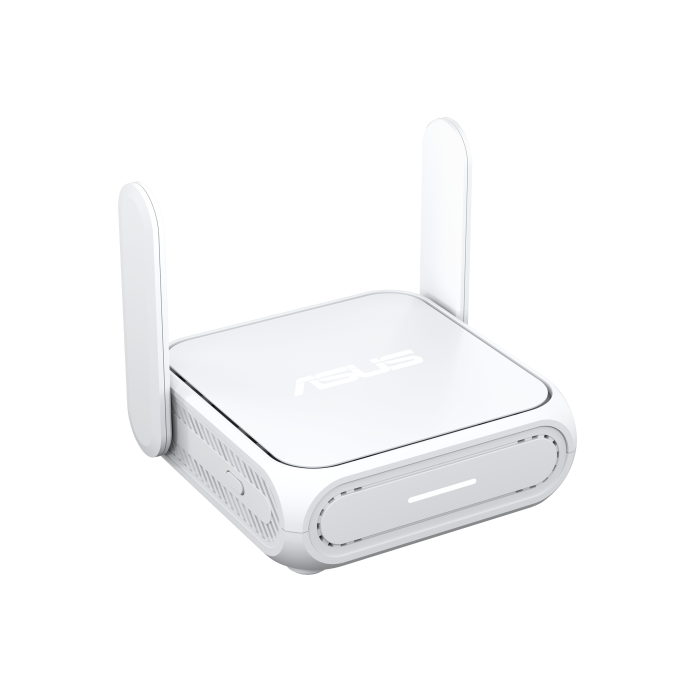
Under the hood of this small 99 x 111 x 36 mm square we find surprisingly muscular hardware for the category: a 2.0 GHz quad-core processor supported by 1 GB of DDR4 RAM and 256 MB of Flash memory. Being a BE3600-class Wi-Fi 7 router, it supports theoretical speeds of up to 2882 Mbps on the 5 GHz band and 688 Mbps on the 2.4 GHz band. Curiously, despite being Wi-Fi 7, it is a dual-band device: it lacks the 6 GHz frequency, but compensates with support for 4K-QAM and MLO (Multi-Link Operation) technology to stabilize the signal. On the back we find an asymmetrical port array: a 2.5 Gbps WAN for connections and a 1 Gbps LAN for wired devices. Power management is handled by a USB-C port that accepts 9V or 12V power supplies; ASUS has wisely included a power adapter in the box, but the fact that it uses the USB-C standard also makes it compatible with some power banks (but not the ones that only supply 5V!)

Design
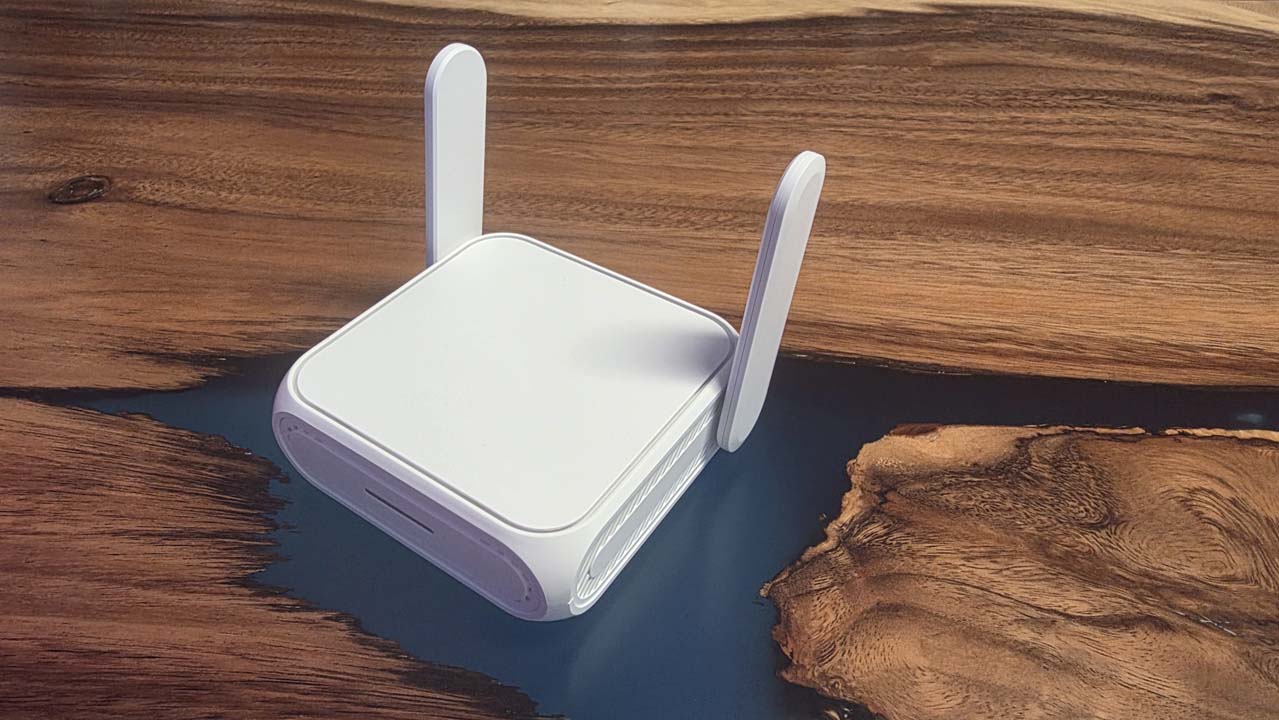
The design is clean, with a matte white finish that's elegant but can easily get dirty, often ending up in backpacks and bags (a black version wouldn't hurt!). The two side antennas are foldable, making them easy to carry and allowing them to be oriented to cover dead zones in buildings with thick walls. The inclusion of a programmable physical button on the side is very clever, which can be configured via the app to quickly activate features like VPN or guest Wi-Fi.
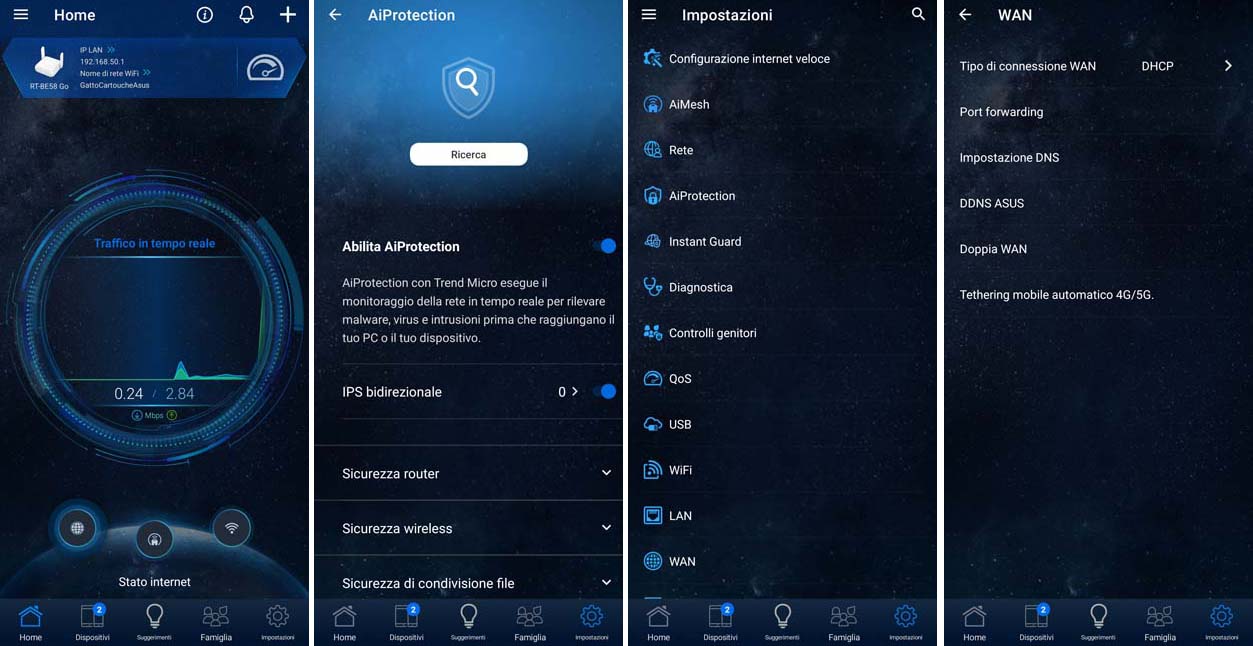
On the software level, the router integrates AiProtection Classic with two-way IPS and extensive VPN support (WireGuard, OpenVPN, Surfshark, NordVPN), providing hardware protection that public networks simply don't offer. The WISP (Wireless Internet Service Provider) feature is also quite impressive: it allows the router to connect to a hotel's Wi-Fi (for example) and create a private subnet to which all your devices, already configured at home, can instantly connect without having to enter the hotel password on each individual device.
Field test
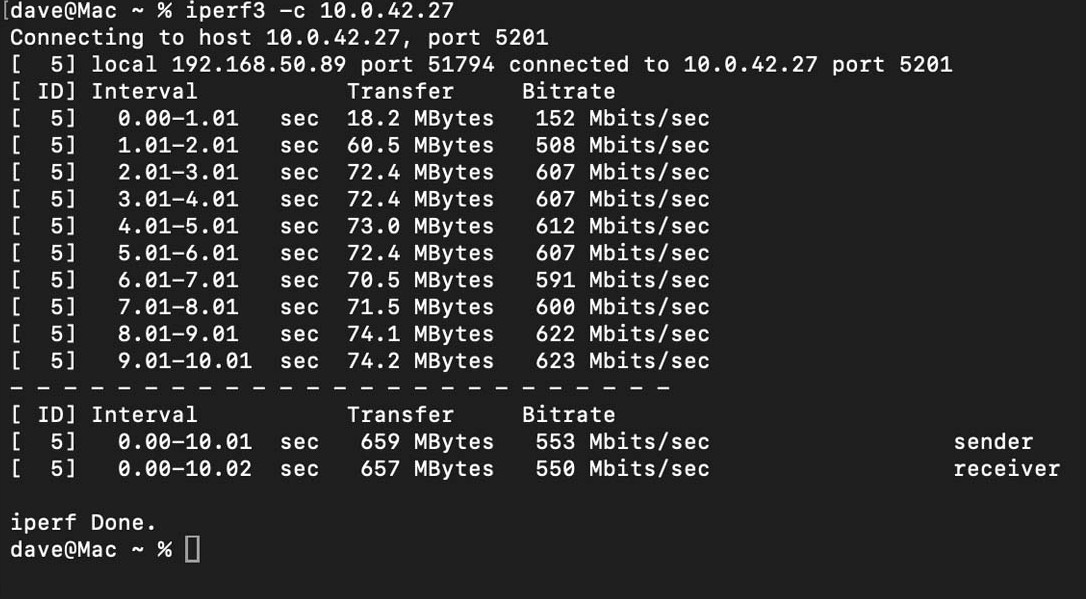
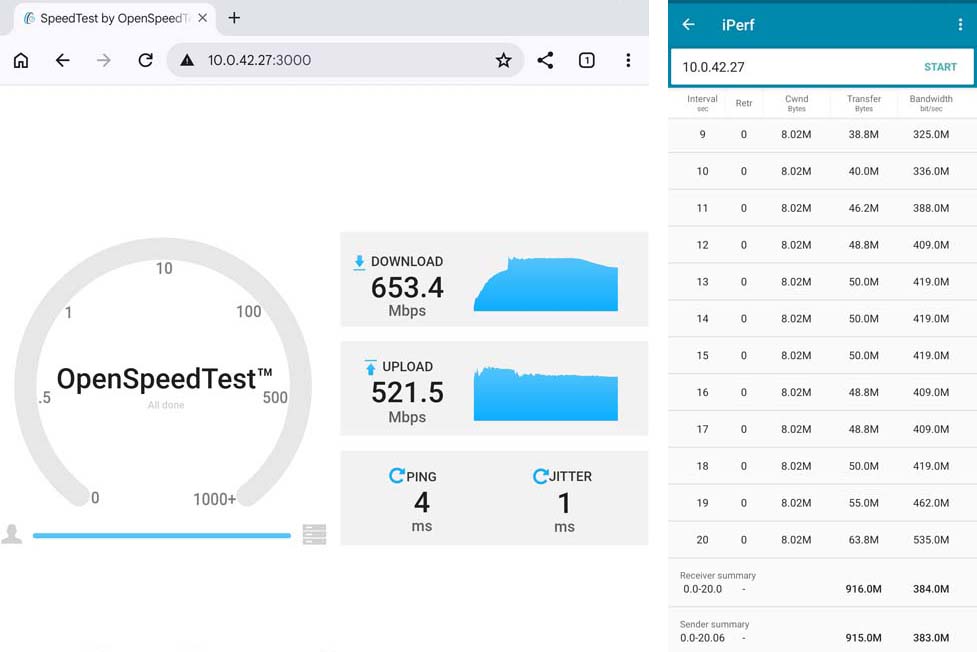
In our field tests, setup was quick, simply using the usual (and comprehensive) ASUS Router app. As for the device's performance, connected via cable to a PC with a 5 Gbps card, the router completely saturated the LAN port, scoring a solid 1.0 Gbps on fast.com. On Wi-Fi, while not a pure speed monster, the results were more than satisfactory: a MacBook M4 reached 682.6 Mbps download on OpenSpeedTest with an iPerf3 average of around 550 Mbps.
The Samsung ZFold 7 performed similarly, achieving a download speed of 653.4 Mbps. Power consumption is negligible, hovering between 3 and 6 watts, and heat is dissipated passively without any noisy fans. A minor annoyance is the reboot time (about 1-2 minutes) every time you change modes or source Wi-Fi networks.
Conclusion
The ASUS RT-BE58 Go is a solid product that offers significantly better security than connecting your PC directly to an Ethernet network or public Wi-Fi whose risks we're unaware of. The price of around 94 CHF is spot on for the technology it offers, especially considering the quad-core processor and Wi-Fi 7. The biggest flaw remains the lack of a built-in 5G modem: in an era when many hotels are eliminating Ethernet ports from rooms, having to rely on the Wi-Fi source or an external USB dongle (which the router supports very well, or via tethering) is a limitation we would have preferred not to have. However, if you're looking for a portable security hub to manage VPNs and protect your data while traveling, this small device is very intriguing.

